Thailand

Digital Lives Decoded 2025
Telenor began our journey in Thailand in the year 2000, amidst the excitement of the new millennium. Over the past 25 years, we have witnessed and contributed to Thailand’s remarkable digital transformation.
Today, as we mark this 25-year milestone, we find ourselves at another defining moment in the country’s digital evolution. Thailand’s digital landscape is undergoing a profound transformation, with AI entering the lives of Thai mobile internet users, often in invisible ways. From enhancing productivity and personalisation, to reshaping education and the workplace, AI is here to stay. The Digital Lives Decoded 2025 report offers a timely look into how AI is reshaping lives in Thailand, and how people are responding to this shift with both optimism and caution.
As our findings reveal, the challenge lies not in adoption of AI, but in ensuring that AI is used responsibly, ethically, and inclusively.
There is no doubt that AI is a powerful technology. And the real determinant of its future lies in how responsibly we use it. Upholding ethical standards, ensuring human oversight, and demanding transparency in how AI systems make decisions are no longer optional – they are essential. Additionally, with AI readily available in everyone’s pocket, the systems behind it must be built on strong, secure, and scalable infrastructure. Trust and security are increasingly the bedrock of any digital society.
This report reflects a shared belief in Thailand’s potential. The outlook on the future impact of AI is resoundingly optimistic, pointing to a future rich with economic opportunity, innovation, and progress if we are able to make the most out of technologies like AI, IoT and advanced digital services.
With Thailand positioning itself to become a regional AI hub, * we hope this whitepaper serves as a valuable resource for policymakers, educators, businesses, and individuals alike. The impact of this rapidly evolving technology needs to be evaluated – in terms of awareness, skills, opportunities, and risks – to understand how Thai society can harness AI responsibly and securely, and prepare people to navigate an AI-driven future.
Together, let’s build a digital Thailand where everyone has the tools and confidence to thrive in the age of AI.

Jon Omund Revhaug
Head of Telenor Asia
2025 Snapshot
AI is a daily companion and personal assistant for Thai internet users
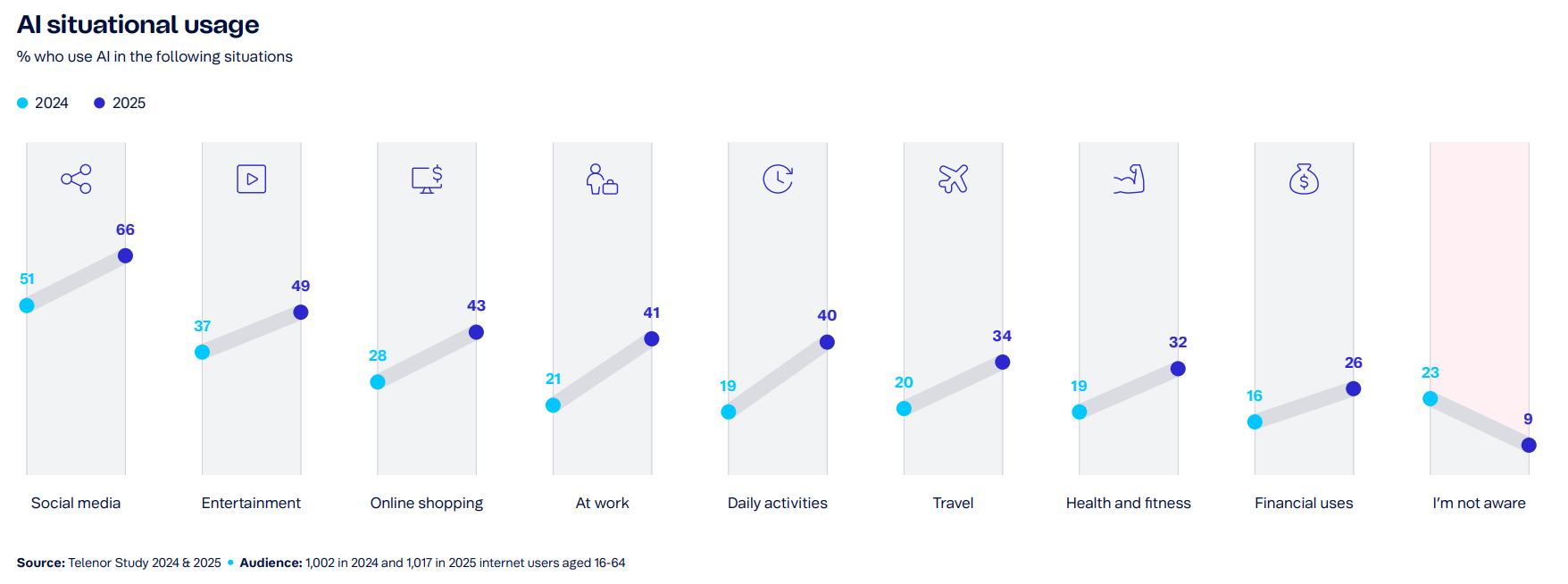
There has been a rapid adoption of AI into everyday life in Thailand. The number of internet users who say they use AI in their daily activities has more than doubled – from 19% in 2024 to 40% in 2025.
Today, 91% of Thai internet users are aware that they use AI in some way, an increase from 77% in 2024. AI is also starting to take on the role of a personal assistant, with around one in two leveraging it for content creation and personalised experience planning.
AI at work: An untapped opportunity for greater productivity
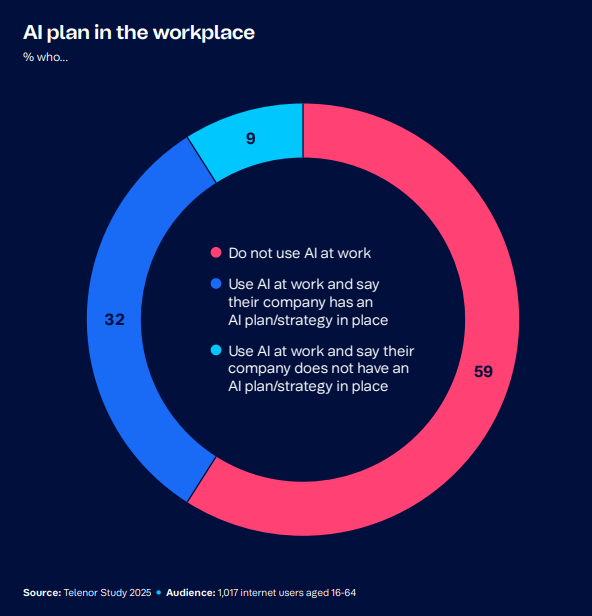
AI is also reshaping the Thai workplace. Today, 4 in 10 use AI at work, doubling from the previous year. Its most common applications are content development, analytics and customer service.
Among those already using AI at work, the outlook is optimistic. They are 31% more likely to believe that AI will have a very positive impact on job security and 32% more likely to expect the same on the country’s economy.
Nonetheless, there remains significant untapped opportunity for increased adoption at work. Currently, only 3 in 10 of AI users at work reported that their company had an AI strategy or plan in place. This suggests a need for clearer organisational direction and support to fully harness the benefits of AI.
Strong personal responsibility in AI upskilling and an expectation for ethical use
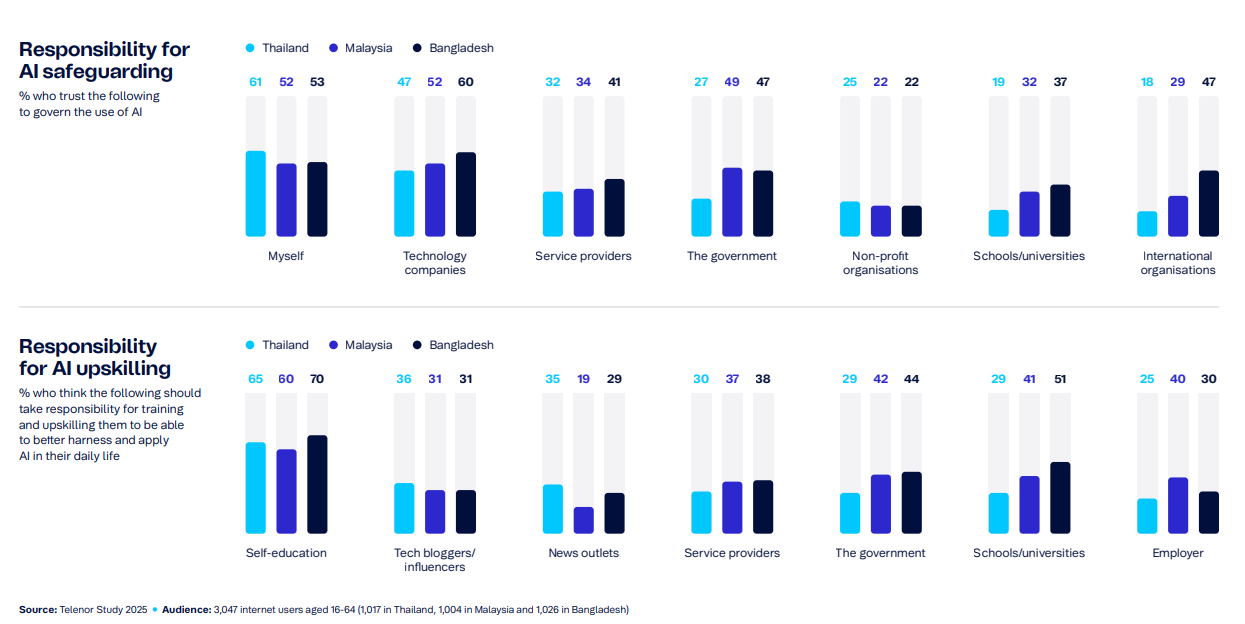
Thai internet users are less likely to expect institutional support and more likely to take ownership of their AI journey. They place the greatest trust in themselves when it comes to governing AI use, and believe it is their personal responsibility to upskill in AI in their daily lives.
This is an interesting contrast to 2024’s study, where those polled looked to institutions like the government (51%) and service providers (47%) to ensure their digital safety. Whether this signals a broader cultural shift toward digital self-reliance or reflects the uniquely personal nature of AI’s integration into daily life, one thing is clear: Thai internet users are not waiting to be led – they are choosing to lead.